As we continued with our studies of the chakras this month, making our way from chakra 4, the heart center, through chakra 5, located in the throat, and on toward chakra 6 (the "third eye") and chakra 7 (the "crown chakra"), an old hymn started running through my mind.
I'll get back to that hymn later, but I need, first, to confess that I never knew, until now, that the hands are also associated with chakra 4. I'm not sure why it's taken me twenty years of yoga study to know that while chakra 4, the heart center, is obviously centered near the middle of the chest, the hands (and shoulders and arms) are also considered part of chakra 4. As we moved toward chakra 5, which obviously is associated with voice, I became very confused because, as a writer, my voice is often expressed with my hands.
I do, of course, talk in the normal way, using my vocal chords and mouth, but I almost always have to write something out before I know what my heart is saying to me. And I am often trying to find the right voice for a character, or the right voice to use for an article I'm writing. I rejoiced, like all writers do, when I felt I had found "my voice" as a writer, and the words began to flow easily and without effort. I, therefore, have had a very hard time separating my heart, my hands and my voice. I didn't know whether it was even possible for me to differentiate these two important energy centers.
And then this hymn started playing in my head. Over and over and over. It's a very old Christian hymn, written around 1636 by a German clergyman, Martin Rinckart, just as the plague descended on his town, eventually killing upwards of 8000 people there.
Rinckart obviously wrote the words of this hymn in German, but the best-known English translation goes like this:
Now thank we all our God, with heart and hands and voices,
Who wondrous things hath done, in whom his world rejoices,
Who from our mother's arms hath blessed us on our way
With countless gifts of love, and still is ours today.
I've always associated this hymn with the Mayflower pilgrims since, as children, we often sang it in church or Sunday School around Thanksgiving Day. Although it is clearly a song of thankfulness, I have always picked up on a strain of underlying suffering, which made sense, knowing that the pilgrims had just made it through a very tough year and were facing another harsh winter. Now, knowing the situation that the author himself was in, trying to minister to a flock that was suffering greatly, called on to bury thousands of his parishioners, I now see that there is much, much more to the story behind this hymn.
Despite the somewhat dated language (the use of words like "hath" and the sometimes-jarring reference to God using a male pronoun), I love this hymn, and not just because I've been singing it since childhood. Martin Rinckert's hymn is a hymn of devotion, so by singing it I can practice bhakti yoga, the yoga of devotion.
I also love how Rinckart's hymn reminds me that my act of devotion can be offered up not just with my voice, but also with my heart as well as with my hands. I love the reminder that true thankfulness and gratitude comes by offering our heart and a hand to another, that it is often in the doing for others that we most deeply experience true gratitude. I love the deep lesson of this text that when we are truly thankful, the heart, hands and voice really cannot be separated.
Namate.
Last week in our yoga in-depth studies class, we began an exploration of the third chakra. This energy center, which is physically located in the belly at the position of the solar plexus, has always seemed rather murky and mysterious to me. I've understood the basic idea behind this chakra--that it's associated with fiery energy as well as with our sense of personal power--but, beyond that, it all seemed rather vague.
This week I think I've finally begun to "get" this chakra, thanks to Anodea Judith's excellent book, "Eastern Body, Western Mind: Psychology and the Chakra System as a Path to the Self." I've had this book for a couple of years and have been re-reading the sections as we've come to them in class, and this week I had one of those "aha!" moments when I came upon this sentence:
"Many people do not awaken this chakra at all, and spend their whole lives following the path of least resistance, giving their power to others, and defining themselves in terms of what is expected."
I suspect a lot of people would not think that a sentence like the above applies to me, but it really hit home and explained why I have found this whole idea of "personal power" to be rather vague. Judith explains that this chakra's function is to take the basic life energy coming up from chakras one and two and turn it into purpose. Here is where we develop a will. Without a functioning or open third chakra, we sometimes look to others for our purpose, thereby never determining what our true purpose might be.
So, it's been a rather tumultuous week as I've tried to come to grips with this idea, all the while feeling the energy surging upward with a great deal of power. It's all been rather confusing, but one thing is clear: I'm a whole lot more in touch with my belly than I have been in a long time. And that has got to be a good thing.
Judith Lasater, in her book "30 Essential Sequences" that I mentioned in my last post, suggests a mantra to go with each of her daily sequences. The mantra for Day Seven of the weekly sequence is "Letting go is not the same thing as giving up."
While I can see the wisdom in this point of view, and would dearly love to be able to let go of some of the old issues that make emotional and psychological peace elusive at times, not to mention those that cause physical pain and health problems, I had to admit that--until last night--the only alternative to letting go that I could truthfully imagine was, in fact, giving up.
Last night in our yoga "In Depth Studies" class, the instructor led us through an exploration of the second chakra, and in so doing, showed me a new way to think about the sometimes scary idea of "letting go." Physically located in the body at a position where the line between the hip points crosses the line between the naval and the pubic bone, this energy center, chakra two, has always seemed to me to be either vaguely threatening, too powerful to pay much attention to, or profoundly confusing.
The second chakra is, indeed, associated with lots of powerful and potentially scary things, not the least of which is our sexuality. Anodea Judith in her excellent book, "Eastern Body, Western Mind," explains that it is also often considered the seat of our emotions, of desire, need and pleasure. Because of all this, I know I am not the only one who has ever felt overwhelmed or especially vulnerable in this area of my body.
Another aspect of the second chakra, though, is that it is adjacent to the area of the body that allows us to move: the hips and the sacroiliac (SI) joints that connect the pelvis to the spine. So, the second chakra is associated with movement in addition to all the other powerful aspects of life that are located there. The flip side of this rather positive aspect of the second chakra is that energy which is not allowed to move freely through this area can get stuck or sent in the wrong direction, causing problems in the SI joints, back or leg pain, hip problems and many other things none of us want.
So, the lesson in last night's class was a very exciting, but very simple, different way to look at the second chakra. Our instructor led us through a simple exercise of carrying out a sun salutation sequence, which all of us had done many times in our yoga classes, but in a new way. She put on music and encouraged us to let our bodies move as if we were inspired by the sequence, but not rigidly bound to the forms.
Within a few seconds I saw what was happening: we were all dancing, everybody doing a slightly different version of sun salutation, but in a way that was truly a dance. I have always been a person who is easily inspired by music and can slip into tapping my foot, swaying and full-out dancing without too much encouragement, but I have to admit that I had never thought of doing my yoga as a dance.
The wisdom of this simple method greeted me this morning when I woke up, the pain in my hip and right SI joint that had been bothering me for days, completely gone. I had been experimenting with stretches in different directions and different ways, but the simplest approach had eluded me: all I really needed to do was let go and let myself move.
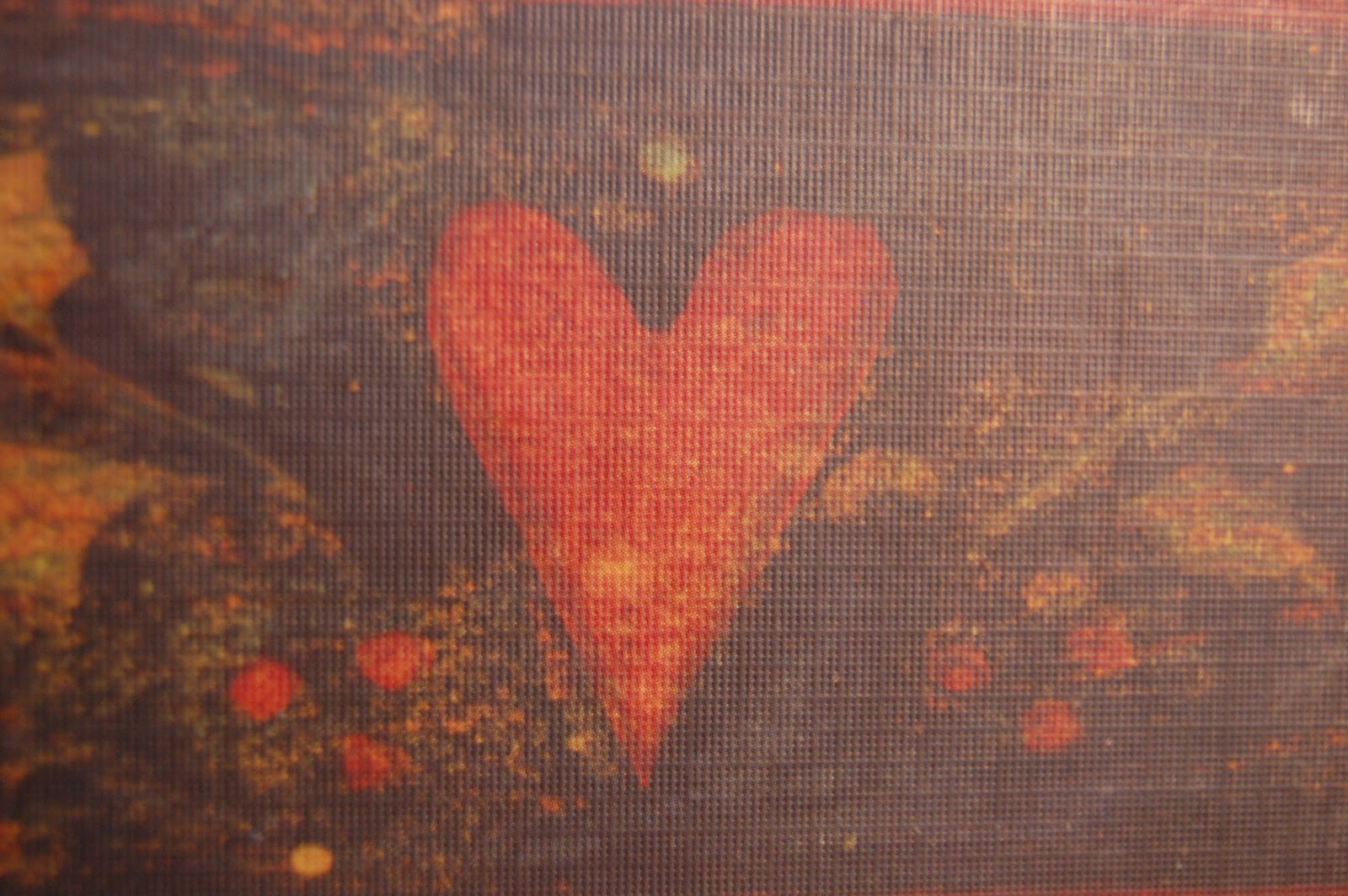
PS: the illustration I've used here is a photo of a painting I made many years ago, on a day when I was especially inspired by music and had learned the wisdom of letting go into movement. The story of how this painting came about will have to wait for another day and another post, though.
In the meantime: Namaste...and remember to dance!